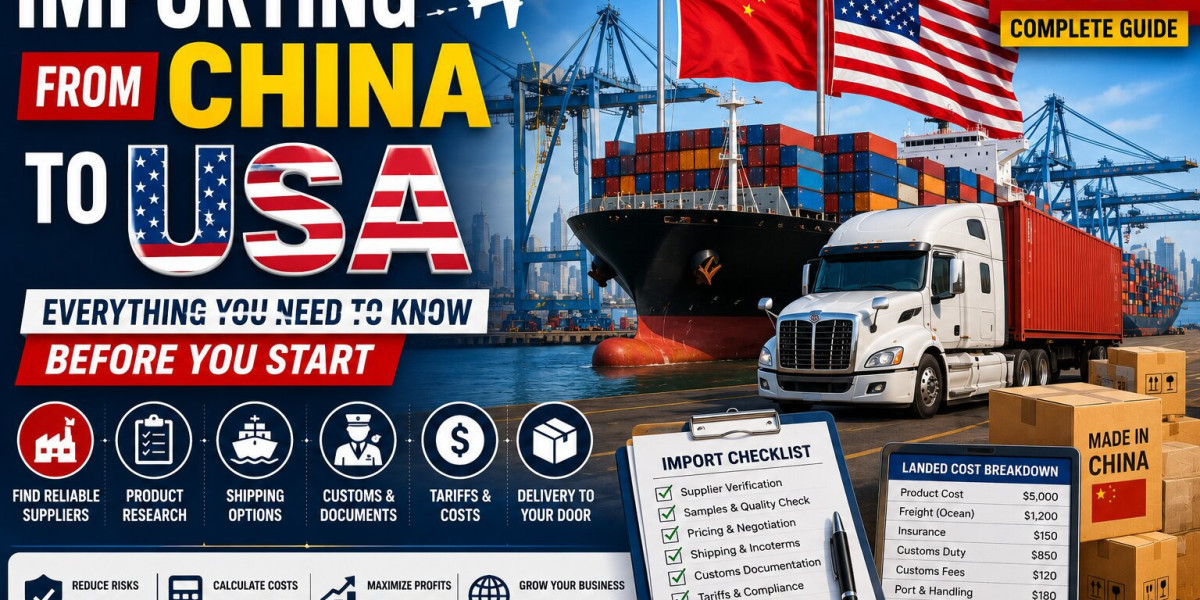

Introduction
China remains an important sourcing market for businesses around the world. From electronics and furniture to machinery, clothing, tools, accessories, and consumer products, American businesses source an enormous variety of merchandise from Chinese manufacturers and suppliers.
For a new importer, however, finding an inexpensive product is only the beginning.
Importing from China to USA involves several moving parts. You need to identify a dependable supplier, evaluate product quality, understand US import requirements, calculate the complete landed cost, choose transportation, prepare documentation, and make sure the shipment can legally enter the American market.
A mistake at any one of these stages can turn an attractive product opportunity into an expensive problem.
The good news is that the process becomes much easier when you approach it systematically.
This guide explains what businesses should know before importing from China, from researching suppliers to receiving products at a US warehouse.
Why Do Businesses Import from China?
China has developed one of the world's largest manufacturing ecosystems. Businesses can find suppliers producing everything from simple consumer goods to highly specialized industrial equipment.
Several factors make China attractive to US importers.
Large Manufacturing Capacity
Chinese manufacturers operate across numerous industries and production categories. This gives businesses considerable flexibility when searching for products.
Competitive Production Costs
Manufacturing costs can be competitive for many product categories, although the final cost depends on materials, specifications, order quantity, quality requirements, and other factors.
Product Variety
Businesses can source private-label products, components, finished goods, packaging, machinery, and specialty products from different manufacturing regions.
Supplier Flexibility
Some manufacturers support customized designs, packaging, labeling, and product specifications.
These advantages make China an appealing sourcing market, but price alone should never determine your purchasing decision.
What Should You Know Before Importing from China?
Before placing your first order, think about the entire journey your product will take.
Your product may move through:
Manufacturer → Export warehouse → Port → Ocean or air transportation → US customs → Domestic carrier → Warehouse → Customer
Each stage can affect your final cost and delivery schedule.
A successful importing strategy therefore begins before you contact a supplier.
Step 1: Research Your Product
The first step in importing from China is deciding exactly what you want to buy.
Start with market research.
Ask yourself:
- Who will buy this product?
- How much are customers willing to pay?
- Who are the existing competitors?
- What makes your product different?
- How frequently will customers purchase it?
- What quantity can you realistically sell?
Do not order thousands of units simply because the supplier offers a lower unit price at a larger quantity.
Inventory only creates value when customers actually want it.
Step 2: Understand Product Regulations
Some products can enter the US with relatively straightforward requirements. Others are subject to detailed federal or industry-specific regulations.
Depending on the product, you may need to consider:
- Safety requirements
- Labeling rules
- Testing
- Certifications
- Environmental regulations
- Food requirements
- Consumer protection rules
- Industry-specific standards
Research these requirements before you pay a supplier.
A product that is inexpensive to manufacture can become a poor investment if you discover later that it requires significant testing, modifications, or additional compliance work.
Step 3: Find Potential Chinese Suppliers
Once you understand the product, begin researching suppliers.
You can evaluate manufacturers through sourcing platforms, trade shows, industry networks, referrals, and direct manufacturer outreach.
When comparing suppliers, look beyond the quoted price.
Consider:
- Manufacturing experience
- Product quality
- Minimum order quantity
- Production capacity
- Communication
- Lead times
- Export experience
- Customization capabilities
- Quality-control procedures
A supplier who communicates clearly and consistently may be more valuable than one offering the lowest initial quotation.
Step 4: Verify Your Supplier
Supplier verification is one of the most important steps for anyone importing from China to USA.
Before making a substantial payment, investigate the business.
Review:
- Company information
- Manufacturing location
- Business history
- Product certifications
- References
- Customer feedback
- Production capabilities
Whenever possible, verify that the supplier actually manufactures the product rather than simply acting as an intermediary.
A third-party inspection or factory audit may also be useful for larger orders.
Step 5: Order Samples
Never assume that a supplier's photographs represent the final product perfectly.
Request samples before placing a large production order.
Evaluate:
- Product materials
- Dimensions
- Color
- Finish
- Functionality
- Packaging
- Labels
- Durability
If you plan to sell the product under your own brand, check how your logo, packaging, and instructions will appear.
A sample gives you an opportunity to identify problems while the financial risk is still relatively small.
Step 6: Negotiate the Commercial Terms
Once you identify a suitable supplier, discuss the commercial terms carefully.
Important areas include:
- Unit price
- Minimum order quantity
- Production time
- Payment schedule
- Packaging
- Product specifications
- Quality standards
- Shipping responsibilities
- Delivery terms
Do not rely solely on verbal promises.
Put important specifications and agreements into written documents so both sides understand what the supplier is expected to deliver.
Step 7: Understand Incoterms
Incoterms define important responsibilities between buyers and sellers in international transactions.
They help establish who handles specific transportation, delivery, risk, and cost responsibilities.
For example, the financial and logistical responsibilities under one delivery term can differ significantly from another.
Before importing from China, make sure you understand the delivery term included in your supplier's quotation.
A low product price can look attractive until you discover that several transportation expenses remain your responsibility.
Step 8: Calculate the Complete Landed Cost
This is where many new importers make mistakes.
The supplier's unit price is not your final cost.
Your landed cost may include:
- Product price
- Packaging
- Inspection
- Export handling
- Inland transportation in China
- International freight
- Cargo insurance
- Customs duties
- Customs-related fees
- Port or terminal charges
- Domestic transportation
- Warehousing
For some products, additional regulatory or compliance costs may also apply.
Calculate these expenses before placing the order.
A product that costs $10 from the supplier does not necessarily cost $10 when it reaches your warehouse.
Step 9: Understand Tariffs and Import Duties
Tariffs and duties can have a significant effect on the economics of importing from China to USA.
The applicable treatment depends on factors such as:
- Product classification
- Country of origin
- Customs value
- Applicable trade measures
- Product-specific requirements
Businesses should determine the appropriate classification and investigate the duties that may apply before purchasing significant quantities.
Do not assume that every product imported from China receives the same tariff treatment.
The classification matters.
Because tariff policies can change, businesses should verify current requirements before each major purchasing decision rather than relying on outdated calculations.
Step 10: Choose the Right Shipping Method
The most suitable transportation method depends on your product, budget, order size, and delivery requirements.
Ocean Freight
Ocean freight is commonly used for larger commercial shipments.
It generally makes sense when:
- Orders are relatively large
- Products are not extremely time-sensitive
- Transportation cost is important
The main drawback is longer transit time.
Air Freight
Air freight offers faster transportation.
It can be useful for:
- Urgent inventory
- Smaller shipments
- High-value products
- Time-sensitive orders
The disadvantage is a higher transportation cost.
Express Shipping
Express carriers can work well for samples and small shipments.
They may provide convenient door-to-door service and tracking.
However, express shipping is usually not the most economical option for large commercial volumes.
Step 11: Prepare Import Documentation
Proper documentation is essential.
Depending on your shipment and product, documents may include:
- Commercial invoice
- Packing list
- Bill of lading
- Air waybill
- Customs entry information
- Product certificates
- Origin documentation
- Permits where required
The information should be accurate and consistent across documents.
Pay close attention to product descriptions, quantities, values, addresses, and country-of-origin information.
Documentation errors can cause unnecessary customs delays.
Step 12: Work With a Customs Broker
Businesses handling international shipments may work with a licensed customs broker to assist with customs entry procedures.
A broker can help with technical aspects of the entry process and documentation.
However, businesses should understand that using a broker does not remove the importer's responsibilities.
The importer still needs to provide accurate product information and understand its compliance obligations.
For first-time importers or companies dealing with complex products, professional customs assistance can make the process easier to manage.
Step 13: Arrange Quality Control
Quality control should not begin when the goods reach your warehouse.
Build quality checks into the purchasing process.
Depending on the product, inspections may take place:
- Before production
- During production
- Before shipment
- After arrival
Pre-shipment inspection can be particularly useful because correcting a problem before the goods leave China is generally easier than returning an entire shipment.
Common Mistakes When Importing from China
Choosing the Cheapest Supplier
The cheapest supplier is not always the most economical supplier.
Poor quality can result in:
- Returns
- Refunds
- Negative reviews
- Lost customers
- Replacements
Compare total value rather than just unit price.
Skipping Samples
Ordering a large quantity without testing a sample creates unnecessary risk.
Always verify important product characteristics before scaling.
Ignoring Compliance
A product may be manufactured successfully but still fail to meet US requirements.
Check applicable regulations before production begins.
Miscalculating Landed Cost
Many importers focus on the supplier invoice and underestimate freight, duties, storage, and domestic delivery.
Calculate the complete cost before determining your selling price.
Ordering Too Much
Volume discounts can be tempting.
But excess inventory can tie up capital for months.
Start with an order size supported by realistic demand forecasts.
How to Reduce Risks
A thoughtful importing process can significantly reduce avoidable problems.
Start Small
Use your first shipment to learn how your supplier and logistics process performs.
Document Everything
Keep purchase orders, invoices, product specifications, inspection reports, and shipping records organized.
Maintain Communication
Regular communication helps identify production or transportation issues early.
Inspect Before Shipment
Where appropriate, arrange quality checks before the products leave the factory.
Monitor Your Landed Cost
Review your actual costs after each shipment and compare them with your original estimates.
This gives you better information for future purchasing decisions.
How to Build a Long-Term China-US Supply Chain
Successful importing is not about completing one shipment.
It is about building a repeatable process.
Over time, businesses should develop reliable systems for:
- Supplier selection
- Quality control
- Purchase orders
- Inventory forecasting
- Transportation
- Customs clearance
- Warehousing
- Customer delivery
You should also evaluate supplier performance regularly.
Track factors such as:
- Defect rates
- On-time production
- Communication
- Price changes
- Shipping performance
These records help you identify which suppliers genuinely support your business.
Tips for First-Time Importers
If you're importing from China for the first time, keep the process manageable.
Before placing your first major order:
- Research the market.
- Identify applicable product regulations.
- Compare several suppliers.
- Verify the supplier.
- Request samples.
- Agree on written specifications.
- Understand the delivery terms.
- Calculate landed costs.
- Research applicable tariffs and duties.
- Select the appropriate transportation method.
- Prepare documentation.
- Plan for customs clearance.
- Inspect the shipment when appropriate.
- Track actual costs and delivery performance.
This approach creates a much stronger foundation than rushing directly into a large order.
Final Thoughts
Importing from China to USA can provide businesses with access to a vast manufacturing ecosystem and a wide range of products. But successful importing requires more than finding a supplier with a low price.
You need to understand the product, research regulations, verify suppliers, test samples, negotiate clear terms, calculate landed costs, select suitable transportation, prepare accurate documents, and plan for customs clearance.
The most important principle is simple:
Know your complete cost and your complete process before you place the order.
When businesses take the time to plan each stage, they can make better sourcing decisions, reduce avoidable risks, and build more reliable international supply chains.
China can be a valuable sourcing market, but the businesses that benefit most are usually those that treat importing as a structured business process rather than simply a purchasing transaction.
Frequently Asked Questions
Is importing from China profitable for US businesses?
It can be, but profitability depends on product demand, purchase price, transportation, tariffs, compliance costs, operating expenses, and selling price. Businesses should calculate the complete landed cost before placing orders.
What is the biggest mistake when importing from China?
One common mistake is focusing only on the supplier's price while overlooking quality, tariffs, freight, compliance, and other landed costs.
Should I order samples before importing from China?
Yes. Samples allow you to evaluate quality, specifications, packaging, and functionality before committing to a larger production order.
Is ocean freight cheaper than air freight?
For many larger shipments, ocean freight can be more economical than air freight. However, the right choice depends on shipment size, urgency, product characteristics, and total logistics costs.
Do I need a customs broker when importing from China to USA?
Not every importer has the same needs, but a customs broker can assist with customs entry procedures and related documentation. Importers remain responsible for providing accurate information and meeting applicable obligations.