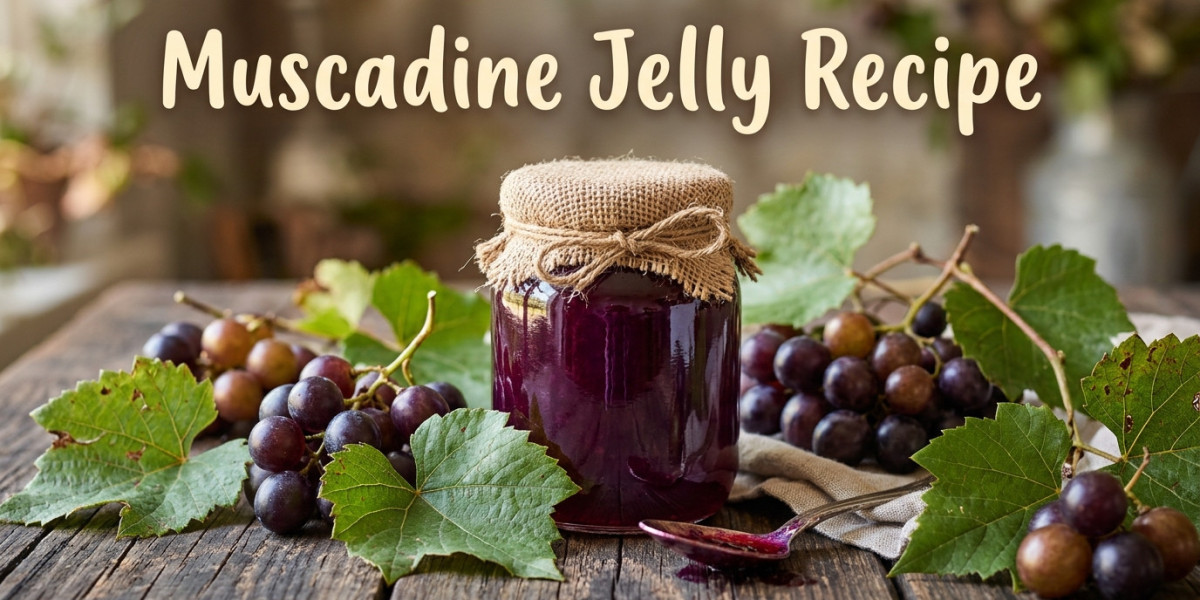

Muscadine grape jelly tastes like a richer, muskier cousin of regular grape jelly. It is sweet and tart at the same time, with a floral, almost wine-like finish. If you have a bucket of muscadines from a backyard vine, a farm stand, or a neighbor, this is the recipe that turns them into something worth saving.
This guide explains how to make muscadine jelly recipe from start to finish. It covers choosing grapes, extracting clear juice, knowing when the jelly has set, fixing a runny batch, and storing the jars safely. The formula comes from the tested no-added-pectin recipe published by the National Center for Home Food Preservation (NCHFP), with practical notes layered on top.
[AUTHOR NOTE: Add 2 to 3 sentences here about your own experience with muscadines, such as where you got the grapes, the variety, and what surprised you the first time you made this. Only include what you actually did. This is the most valuable paragraph on the page for E-E-A-T.]
Why You'll Love This Muscadine Jelly Recipe
- Only two ingredients. Juice and sugar do all the work. The grapes supply flavor, color, and most of the gelling power.
- No boxed pectin. The jelly sets through cooking and the pectin naturally found in the fruit.
- Small batch. A 4-cup juice batch is manageable on a regular stovetop and fits in a standard canner.
- Beautiful color. Dark purple muscadines give a deep ruby jelly. Bronze scuppernongs give a pale amber one.
- Great for gifts. A jar with a handwritten label fits holiday baskets, hostess gifts, and farmers market tables.
- Works across skill levels. Beginners get exact numbers. Experienced canners get troubleshooting detail.
What Is Muscadine Jelly?
Muscadine jelly is a clear fruit spread made from the strained juice of muscadine grapes (Vitis rotundifolia), sugar, and heat. Jelly uses juice only, while jam contains crushed fruit. Muscadines are native to the Southeastern United States and have thick skins, large seeds, and a strong, musky flavor.
A scuppernong is a bronze or golden muscadine variety. You can use dark muscadines, scuppernongs, or a mix. A mixed batch usually gives a rosy jelly with a rounder flavor.
Ingredients
| Ingredient | Amount | Why it matters |
|---|---|---|
| Muscadine or scuppernong grapes | 3½ to 4 pounds | Yields about 4 cups of strained juice |
| Granulated sugar | 3 cups | Builds the gel and acts as a preservative |
That is the entire tested formula. It makes about 3 to 4 half-pint jars.
How to Choose Muscadines for Jelly
- Pick grapes that are just ripe: plump, firm, and fully colored, with unbroken skins.
- Include a small share of slightly underripe fruit. Extension guidance for jams and jellies without added pectin notes that a fourth of the fruit should be slightly underripe, because pectin drops as fruit ripens.
- Skip grapes that are shriveled, moldy, or smell fermented.
- Use grapes within a few days of buying them, or freeze them whole until you are ready.
How Many Pounds of Muscadines Make a Batch?
Plan on 3½ to 4 pounds of grapes for 4 cups of juice. Yield changes with variety, ripeness, and how hard you press, so always measure the strained juice, not the fruit. If you come up short, do not top it off with water. Make a smaller test batch instead, or save the juice and combine it with another harvest later.
Ingredient Substitutions
- Frozen muscadines: Work well. Thaw them partially, then crush and simmer as usual. Frozen fruit releases juice easily.
- Bottled or frozen muscadine juice: Use 100% juice with no added sugar. Measure 4 cups and follow the cooking steps. Because commercial juice may have less natural pectin, rely on a thermometer to confirm the set.
- Scuppernongs: Swap them one for one with dark muscadines.
- Reduced sugar: Do not simply cut the sugar. In a no-pectin recipe, sugar is part of the gel structure. If you want less sugar, switch to a low-sugar pectin product and follow its package directions.
- Honey or sugar substitutes: Skip these in this formula. They change the set and flavor in unpredictable ways.
- Boxed pectin: If you prefer a pectin method, follow the formula inside the pectin box exactly. Those recipes use different juice and sugar amounts, so do not add pectin to this 4 to 3 ratio.
Equipment
- Heavy 8-quart pot for simmering the grapes
- Wide, heavy pot or Dutch oven for boiling the jelly (a wider surface reduces water faster)
- Potato masher
- Fine-mesh strainer and a damp jelly bag or several layers of cheesecloth
- Candy thermometer or instant-read thermometer
- Small plate or metal spoons chilled in the freezer
- Boiling water canner with rack
- 3 to 4 half-pint canning jars with new two-piece lids
- Jar lifter, canning funnel, ladle, bubble remover, clean damp towel
A thermometer is the single best tool for this recipe. Calibrate it first by testing it in boiling water, then adjust for any difference.
How to Make Muscadine Jelly: Step by Step
- Wash and stem the grapes. Discard leaves and any damaged fruit.
- Crush the grapes in a heavy pot with a potato masher until every skin splits. Do not add water.
- Simmer over medium heat for about 10 minutes, stirring often, until the juice runs deep purple.
- Press and strain the mixture through a fine-mesh strainer to separate juice from skins and seeds.
- Settle overnight. Refrigerate the juice for 12 to 24 hours so harmless tartrate crystals fall to the bottom.
- Strain again through a damp jelly bag or cheesecloth without squeezing. Measure exactly 4 cups.
- Prepare the canner. Heat the water, wash the jars, keep them hot, and chill a plate or spoons.
- Boil the juice, then add 3 cups of sugar and stir until dissolved.
- Cook to the gel point: 220°F at sea level, or 8°F above the boiling point of water where you live.
- Skim, fill, and seal. Ladle into hot jars with ¼ inch headspace, wipe rims, and apply lids fingertip tight.
- Process in a boiling water canner for the time in the altitude table below.
- Rest and cool. Turn off the heat, wait 5 minutes, then lift the jars out and let them sit undisturbed for 12 to 24 hours.
The Juice Stage in Detail
Muscadine skins are thick, so simmering without added water works well. The skins soften, the juice releases, and the flavor stays concentrated. Press gently. Squeezing the pulp hard pushes fine particles into the juice and clouds the finished jelly.
The overnight rest is optional but worth doing. Grape juice naturally forms tiny tartrate crystals when chilled. If you skip the rest, they can show up as sandy specks in the jars. Harmless, but not pretty.
How to Tell When Muscadine Jelly Is Done
Use at least one of these tests, and use the thermometer if you have one.
| Test | How | Done when |
|---|---|---|
| Thermometer | Insert in the boiling jelly | 220°F at sea level, or 8°F above boiling water at your elevation |
| Sheeting test | Dip a cool metal spoon, lift, and tilt | Drops merge and fall off as one sheet |
| Cold plate test | Spoon onto the frozen plate, wait 30 seconds, push with a finger | The surface wrinkles |
Remove the pot from the heat while you test so it does not overcook. Cooking time varies with pot width and batch size, but expect roughly 10 to 20 minutes of rapid boiling. Trust temperature, not the clock.
Processing Times by Altitude
| Altitude | Half-pint jars |
|---|---|
| 0 to 6,000 feet | 10 minutes |
| Above 6,000 feet | 15 minutes |
NCHFP's general table for jelly without added pectin lists shorter times at the lowest altitudes (5 minutes up to 1,000 feet, then 10 and 15 minutes). Using 10 minutes up to 6,000 feet meets or exceeds both versions and is a safe choice. Start timing only after the water returns to a full rolling boil, and keep the jars covered by 1 to 2 inches of water.
Cooking Tips From the Kitchen
- Make the juice a day early. Straining and settling overnight spreads the work across two days and gives clearer jelly.
- Cook one batch at a time. Do not double the recipe in one pot. Large volumes take longer to reach the gel point, and extension sources warn that big batches of pectin-free jelly can fail to set. Run two separate batches instead.
- Use a wide pot. More surface area means faster evaporation and a quicker, cleaner set.
- Skim foam at the end. Foam does not affect safety or flavor, but removing it gives jewel-clear jars.
- Keep jars hot. A hot jar prevents thermal shock when the boiling jelly hits the glass.
- Judge the set tomorrow, not tonight. Jelly firms up as it cools and can take 24 to 48 hours to reach final texture.
- Label and date. Write the month and year on every lid.
[AUTHOR NOTE: Add one real tip from your own batch, such as how long your pot took to reach 220°F, how much juice you got from a given weight, or a color difference between dark and bronze grapes.]
Common Mistakes to Avoid
- Squeezing the jelly bag. This forces pulp through and clouds the jelly.
- Guessing the set by time. Different pots and stoves behave differently. Use a thermometer.
- Cutting the sugar. In this formula, less sugar means a runny result and weaker preservation.
- Overcooking. Boiling far past 220°F produces a stiff, rubbery, dark jelly.
- Doubling the batch. Make two batches instead.
- Reusing lids. Always use new two-piece lids for canning.
- Skipping the headspace. Too little or too much headspace can prevent a proper seal.
- Moving jars while they set. Disturbing them can break the gel and cause weeping.
- Using only very ripe fruit. Fully ripe grapes have less pectin, so include a few slightly underripe ones.
Troubleshooting Muscadine Jelly
| Problem | Likely cause | What to do |
|---|---|---|
| Runny jelly | Undercooked, too little sugar, or low-pectin fruit | Wait 48 hours first. If still loose, remake using NCHFP's soft jelly instructions, or use it as syrup |
| Rubbery or very stiff | Overcooked | Use as a spread on a cheese board, or slice thin like fruit paste |
| Cloudy jelly | Squeezed bag or pulp in the juice | Strain gently and filter the juice twice next time |
| Sandy crystals | Tartrate crystals or undissolved sugar | Chill and decant the juice, and stir until sugar fully dissolves |
| Foam in the jar | Skimming skipped | Skim before filling |
| Weeping liquid on top | Jars moved early or storage temperature swings | Keep jars still and store in a steady cool spot |
| Mold or off smell | Failed seal or contamination | Discard the whole jar |
The remake method is spelled out in the "Remaking soft jellies" section of the USDA Complete Guide to Home Canning, Guide 7. Follow those quantities rather than improvising.
Muscadine Jelly Variations
- Muscadine jam: Keep the pulp for a chunkier spread.
- Muscadine pepper jelly: Stir hot peppers into the juice. For canning, use a tested pepper jelly recipe, because added vegetables change the safety profile.
- Herb-infused jelly: Steep rosemary or thyme in the warm strained juice for 10 minutes, then strain it out before boiling.
- Spiced jelly: Simmer a cinnamon stick or a split vanilla bean in the juice, then remove it.
- Mixed grape jelly: Blend muscadine and scuppernong juice for a more rounded flavor.
- Refrigerator-only jelly: Skip the canner and keep jars in the fridge.
- Dietary notes: The recipe is naturally vegan, gluten-free, dairy-free, and nut-free. It is not low-sugar.
How to Serve Muscadine Jelly
Muscadine jelly pairs best with buttery, salty, or rich foods that its tartness can balance.
- Spread it on hot biscuits or toast. It also sits well next to the pastry in these caramel rolls recipes at a brunch table.
- Brush warmed jelly over baked ham in the last minutes of cooking. Browse more ham recipes for ideas.
- Use it as a glaze for roasted or grilled chicken. These chicken recipes, easy chicken breast recipes, and rotisserie chicken recipes all take well to a sweet-tart finish.
- Spoon it over a healthy dinner of lean pork or turkey as a light glaze.
- Add a bowl to a cheese board, or set it beside bread and cured meats at a fondue party. A small dish pairs nicely with the cheeses in these easy fondue recipes.
- Fill thumbprint cookies or spread it between layers of a simple cake. Try it with cake recipes that call for a fruit filling.
- Stir a spoonful into yogurt or oatmeal.
- Mix it with barbecue sauce for a fruity edge on meatballs or pork.
- Pair a jar with simple candied orange slices in a homemade holiday gift basket.
- Drizzle slightly warmed jelly over a holiday side like easy candied yams for a tart contrast.
Storage
| Method | How long | Notes |
|---|---|---|
| Sealed jars, cool dark pantry | About 1 year for best quality | Check seals before opening |
| Opened jar, refrigerator | About 1 month | Use a clean spoon each time |
| Jar that did not seal, refrigerator | About 1 month | Treat it as opened |
| Freezer | Up to 6 months | Use straight-sided freezer-safe jars and leave 1 inch of headspace |
| Strained juice, freezer | Up to 1 year | Freeze in 4-cup portions for later batches |
Discard jelly with mold, a fermented or alcohol smell, a bulging lid, or any broken seal. Do not scrape mold off and eat the rest.
Reheating
Canned jelly does not need reheating, but warming it makes a better glaze or dessert sauce. Spoon the amount you need into a small saucepan and warm it over low heat until pourable, or microwave it in 15-second bursts. Do not re-boil or re-can jelly that has already set. If a jar failed to seal, refrigerate it and eat it soon instead.
Freezing Muscadine Jelly
Freezing is a good option for small batches or if you want to skip the canner. Fill straight-sided freezer-safe jars, leave 1 inch of headspace for expansion, cool completely, and freeze for up to 6 months. Thaw overnight in the refrigerator and use within a few weeks. Freezing the strained juice is even more flexible, since you can make jelly any time of year.
Make-Ahead Instructions
- Extract and strain the juice up to a day ahead and keep it in the refrigerator.
- Freeze 4-cup portions of juice and make jelly in winter when you have time.
- Wash jars and arrange the canner the night before.
- Cook the jelly in the morning, when you can watch it carefully and let the jars cool undisturbed all day.
Food Safety Notes
Home canning is safe when you use tested recipes, correct headspace, new lids, and proper processing times. High sugar and fruit acid make jelly a lower-risk preserve, but you should still follow official guidance. The NCHFP is the USDA-backed source for tested home canning recipes. Your state Cooperative Extension office, such as University of Arkansas Extension's muscadine jelly tips, also publishes helpful notes. One extension reminder is worth repeating: the no-added-pectin method works best with fruits that are naturally high in pectin, and muscadines can vary, so a thermometer and a patient wait of 24 to 48 hours matter.
Nutrition Information
A tablespoon of muscadine jelly provides roughly 40 to 50 calories and about 12 grams of sugar, with almost no fat or protein. Treat these numbers as estimates because they depend on yield and serving size. The jelly is a sweet condiment, not a health food, so enjoy it in small portions.
Muscadine Jelly Recipe Card
Muscadine Jelly (No Added Pectin)
Prep time: 1 hour Cook time: 20 minutes Processing time: 10 minutes Additional time: Overnight settling, 12 to 24 hours cooling, up to 48 hours to fully set Yield: 3 to 4 half-pint jars (about 64 servings of 1 tablespoon) Calories: About 45 per tablespoon (estimate)
Ingredients
- 3½ to 4 pounds muscadine or scuppernong grapes (for 4 cups juice)
- 3 cups granulated sugar
Instructions
- Wash and stem the grapes. Crush them in a heavy pot without water.
- Simmer for 10 minutes, stirring often.
- Press through a fine-mesh strainer. Refrigerate the juice overnight.
- Pour off the clear juice and strain through a damp jelly bag without squeezing. Measure 4 cups.
- Heat the canner, wash and warm the jars, and chill a plate or spoons.
- Bring the juice to a boil. Add 3 cups sugar and stir until dissolved.
- Boil rapidly to 220°F (8°F above the boiling point of water at your elevation), or until the jelly sheets from a spoon.
- Skim foam. Ladle into hot jars with ¼ inch headspace. Wipe rims and apply lids fingertip tight.
- Process in a boiling water canner for 10 minutes (0 to 6,000 ft) or 15 minutes (above 6,000 ft).
- Turn off the heat, wait 5 minutes, remove jars, and cool undisturbed for 12 to 24 hours. Check seals and label.
Notes
- Do not double the batch. Make a second batch instead.
- Confirm processing times against current NCHFP guidance before canning.
Frequently Asked Questions
How do you make muscadine jelly?
Crush muscadine grapes, simmer them for 10 minutes without water, strain the juice, and boil 4 cups of juice with 3 cups of sugar to 220°F. Ladle into hot jars and process in a boiling water canner.
Can you make muscadine jelly without pectin?
Yes. This recipe sets through cooking and the natural pectin in the grapes. Use a thermometer and give the jars 24 to 48 hours to firm up, because pectin content varies.
How many pounds of muscadines do you need for jelly?
About 3½ to 4 pounds of grapes for 4 cups of juice, which makes 3 to 4 half-pint jars. Always measure the juice rather than the fruit.
Do you have to peel or seed muscadines for jelly?
No. Crush the whole grapes, skins and seeds included, then strain. The skins also contribute pectin and color.
Can I use frozen muscadines or bottled juice?
Yes. Thaw frozen grapes partly before crushing. For bottled juice, choose unsweetened 100% juice and confirm the set with a thermometer.
How do I know when muscadine jelly is done?
It is done at 220°F (8°F above boiling at your elevation), or when drops merge and sheet off a cool spoon, or when a dab wrinkles on a frozen plate.
Why is my muscadine jelly runny?
The usual causes are undercooking, too little sugar, or fruit that was very ripe. Wait 48 hours, then remake it following NCHFP's soft jelly directions or use it as syrup.
Why is my muscadine jelly cloudy or gritty?
Cloudiness comes from squeezing the jelly bag. Grit usually comes from tartrate crystals. Let the juice drain naturally and rest it overnight before straining again.
How long does homemade muscadine jelly last?
Properly processed jars keep about a year in a cool, dark pantry. Opened jelly lasts about a month in the refrigerator.
Do I have to water-bath can muscadine jelly?
Only for pantry storage. A jar that is merely sealed with a hot lid is not a safe shelf-stable seal. Otherwise, refrigerate the jars and use them within about a month, or freeze them.
Can I freeze muscadine jelly?
Yes. Use freezer-safe jars with 1 inch of headspace and freeze for up to 6 months. Thaw in the refrigerator.
Can I double this muscadine jelly recipe?
It is better not to. Large volumes take longer to reach the gel point and may not set. Make separate batches.
What is the difference between muscadine and scuppernong jelly?
Scuppernongs are a bronze muscadine variety, so the jelly is usually paler and slightly milder. The method is identical.
Can I use less sugar?
Not in this formula. For lower sugar, use a low-sugar pectin and follow its package instructions.
Final Thoughts
A good muscadine jelly depends on four things: just-ripe grapes, clear juice, an exact 4 to 3 ratio, and a thermometer-checked gel point. Get those right and you will have jewel-toned jars that last all year.
If this is your first time canning, start with a single batch, keep notes on your yield, and share your results in the comments. Then pair a jar with homemade date syrup or other pantry staples for a thoughtful gift.