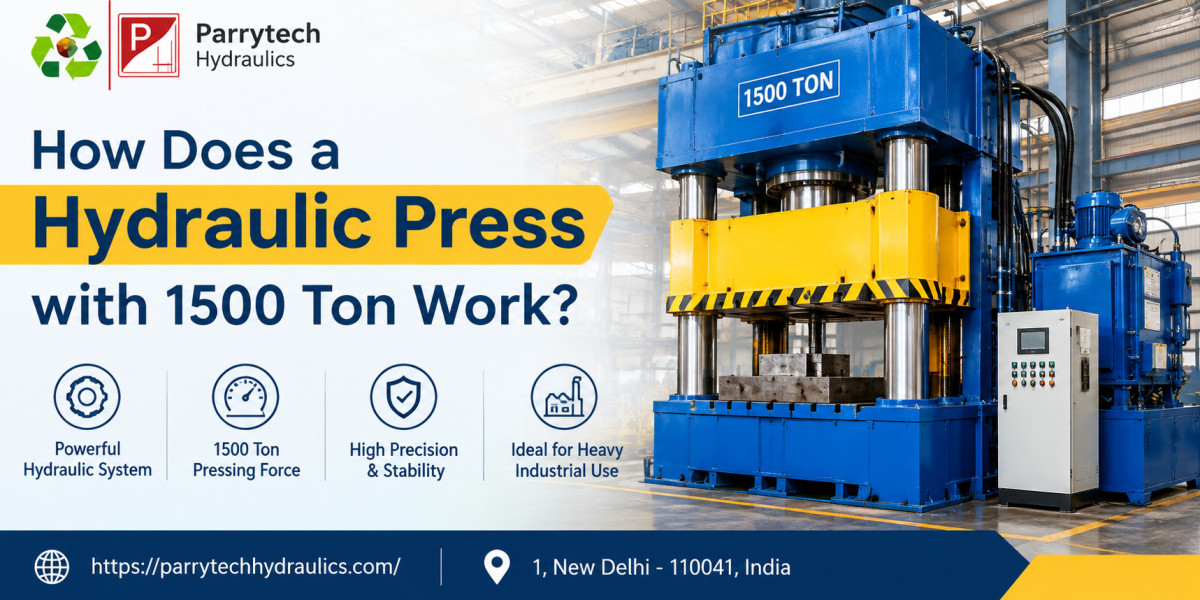

When a manufacturing process requires very high force, a Hydraulic Press with 1500 Ton Delhi can provide the strength and controlled movement needed for heavy-duty operations.
But how does a machine of this capacity work, and what should manufacturers consider before selecting one? Let’s understand its working principle, applications, important features, and the practical experience involved in designing and supporting heavy hydraulic machinery.
What Is a 1500-Ton Hydraulic Press?
A 1500-ton hydraulic press is a heavy-duty machine designed to generate up to approximately 1500 tons of pressing force, depending on its configuration.
The machine does not use mechanical force alone. It uses hydraulic fluid, pumps, valves, cylinders, and controls to generate and manage the required force. When hydraulic fluid is pressurized and directed toward the cylinder, it moves the piston and ram. The ram then applies force to the material placed on the press bed.
The final machine configuration depends on the application. Material type, component dimensions, die size, stroke, daylight, bed size, production cycle, and automation requirements all need to be considered.
How Does a Hydraulic Press with 1500 Ton Work?
The working principle of a hydraulic press is based on Pascal’s law. Pressure applied to a confined hydraulic fluid is transmitted throughout the fluid, allowing the system to produce a much larger mechanical force through the hydraulic cylinder.
The operation normally takes place in several stages.
1. Placing the Material
The workpiece, sheet, blank, or component is positioned on the press bed. The appropriate die and tooling are installed according to the manufacturing process.
2. Generating Hydraulic Pressure
The hydraulic power unit supplies pressurized fluid through the hydraulic circuit. Pumps, valves, pipes, and controls work together to manage the flow and pressure.
3. Moving the Ram
The pressurized hydraulic fluid enters the cylinder and moves the piston. This movement transfers force to the ram.
4. Applying Pressing Force
The ram moves toward the workpiece and applies the required force. The amount and movement of force depend on the particular operation.
5. Completing the Operation
The material may be formed, compressed, bent, moulded, stamped, or deep drawn depending on the tooling and machine configuration.
6. Returning the Ram
After the operation is completed, the hydraulic system controls the return movement of the ram so the next production cycle can begin.
This controlled hydraulic movement is one reason hydraulic presses are used for demanding industrial applications.
What Are 1500-Ton Hydraulic Presses Used For?
A 1500-ton press can be designed for different heavy-duty manufacturing processes. Typical applications can include:
Heavy metal forming
Deep drawing
Automobile component manufacturing
Rubber moulding
Industrial pressing
Sheet metal forming
Compression operations
Special-purpose forming applications
The required configuration can vary considerably between applications. For example, deep drawing may require a blank holder or die cushion depending on the component and forming process.
Parrytech Hydraulics' product portfolio includes hydraulic presses, hydraulic deep draw presses, rubber moulding presses, hydraulic transfer moulding presses, hydraulic press brake machines, hydraulic shearing machines, hydraulic cylinders, and hydraulic power packs. Its website also lists hydraulic presses up to 3000-ton capacity for automobile applications.
Parrytech Hydraulics: Experience in Hydraulic Engineering
When selecting a heavy hydraulic press, the manufacturer's practical engineering capability is an important consideration.
Parrytech Hydraulics states that it has an experienced team of engineers and professionals working on hydraulic and recycling equipment. The company says its team focuses on providing solutions according to different customer requirements while keeping up with developments in the industry.
Its experience is reflected not only in its product range but also in the services it provides. Parrytech offers custom hydraulic system design, where hydraulic solutions are engineered for different industrial requirements with attention to control, efficiency, and scalability.
The company also provides repair and maintenance, upgrades, and breakdown support. For large hydraulic machinery, these services are important because regular maintenance and timely technical support can help reduce unnecessary equipment downtime.
Parrytech also handles installation and commissioning, including on-site machine setup, testing, and training. This means its involvement can continue beyond manufacturing and extend into putting the hydraulic system into operation correctly.
This practical involvement is particularly relevant for a 1500-ton press because heavy hydraulic equipment requires proper attention to the hydraulic system, machine structure, controls, tooling, installation, testing, and maintenance.
Engineering and Quality Approach at Parrytech
Parrytech's website highlights precision engineering supported by in-house R&D. According to the company, its hydraulic systems are developed using modern technology with a focus on accuracy and long-term performance.
The company also states that each machine undergoes rigorous quality checks and follows manufacturing standards intended to support durability, efficiency, and reliability.
For a high-capacity hydraulic press, this type of manufacturing approach matters because the machine must handle substantial force while maintaining controlled movement and dependable operation.
The company further describes its workflow from design to dispatch as being organized around streamlined operations and customer communication. It also mentions maintenance alerts and upgrade options for its machines.
What Should You Check Before Buying a 1500-Ton Press?
Before selecting a heavy-duty press, manufacturers should discuss the complete production requirement with the hydraulic equipment manufacturer.
Important factors include:
Required pressing force
Material type and thickness
Component size
Die dimensions
Stroke length
Daylight
Bed size
Hydraulic pressure and flow
Production cycle
Automation requirements
Safety arrangements
Installation requirements
Maintenance and technical support
Simply selecting a machine because it has a 1500-ton capacity may not be enough. The machine must be properly matched to the manufacturing process.
Why Choose Parrytech Hydraulics?
For businesses searching for a Hydraulic Press with 1500 Ton Delhi, Parrytech Hydraulics offers a combination of hydraulic machinery manufacturing and technical support.
Its current product range covers several types of hydraulic equipment, including hydraulic presses, deep drawing presses, rubber moulding presses, transfer moulding equipment, bending machines, shearing machines, cylinders, and power packs.
The company's stated strengths include precision engineering, in-house R&D, rigorous quality checks, and streamlined delivery operations. It also provides custom hydraulic system design, repair and maintenance, upgrades, breakdown support, installation, commissioning, machine testing, and training.
Parrytech also states that it has established its presence in the hydraulic and recycling equipment market in a short span of just over a year and has built its manufacturing approach around quality, engineering capability, and customer requirements.
For a large machine such as a 1500-ton hydraulic press, this combination of manufacturing, engineering, installation, testing, and after-sales support can be relevant when evaluating a supplier.
How to Select the Right 1500-Ton Hydraulic Press
Every manufacturing application is different. Before finalizing a machine, the manufacturer should understand what the press will actually do.
For deep drawing, factors such as drawing depth, blank size, die arrangement, blank holding, and die cushion requirements can influence the machine configuration.
For general forming or compression, the required force, stroke, bed dimensions, tooling, and production cycle may be more important.
Therefore, the right approach is to discuss the complete application with the hydraulic press manufacturer and develop the machine around the actual production requirement.
Conclusion
A 1500-ton hydraulic press uses pressurized hydraulic fluid to generate and control very high mechanical force. Its hydraulic power unit, cylinders, valves, controls, structure, and tooling work together to complete heavy industrial forming and pressing operations.
For companies looking for a Hydraulic Press with 1500 Ton Delhi, selecting the machine according to the application is more important than looking at tonnage alone.
Parrytech Hydraulics' experience includes hydraulic equipment manufacturing, custom hydraulic system design, experienced engineering professionals, in-house R&D, quality checks, installation and commissioning, testing, maintenance, upgrades, and technical support. Its product range also covers multiple hydraulic press and forming applications.
FAQs
1. What is a 1500-ton hydraulic press?
It is a heavy-duty hydraulic machine designed to generate approximately 1500 tons of pressing force, depending on its configuration.
2. How does a 1500-ton hydraulic press work?
It uses pressurized hydraulic fluid to move a cylinder and ram, which applies controlled force to the workpiece.
3. What can a 1500-ton hydraulic press do?
It can be configured for metal forming, deep drawing, moulding, pressing, and other heavy industrial applications.
4. Can a 1500-ton press be customized?
Yes. Machine configuration can be developed according to the application, tooling, stroke, bed size, and production requirements.
5. What support does Parrytech provide?
Parrytech lists custom hydraulic design, installation, commissioning, testing, maintenance, upgrades, breakdown support, and training among its services.