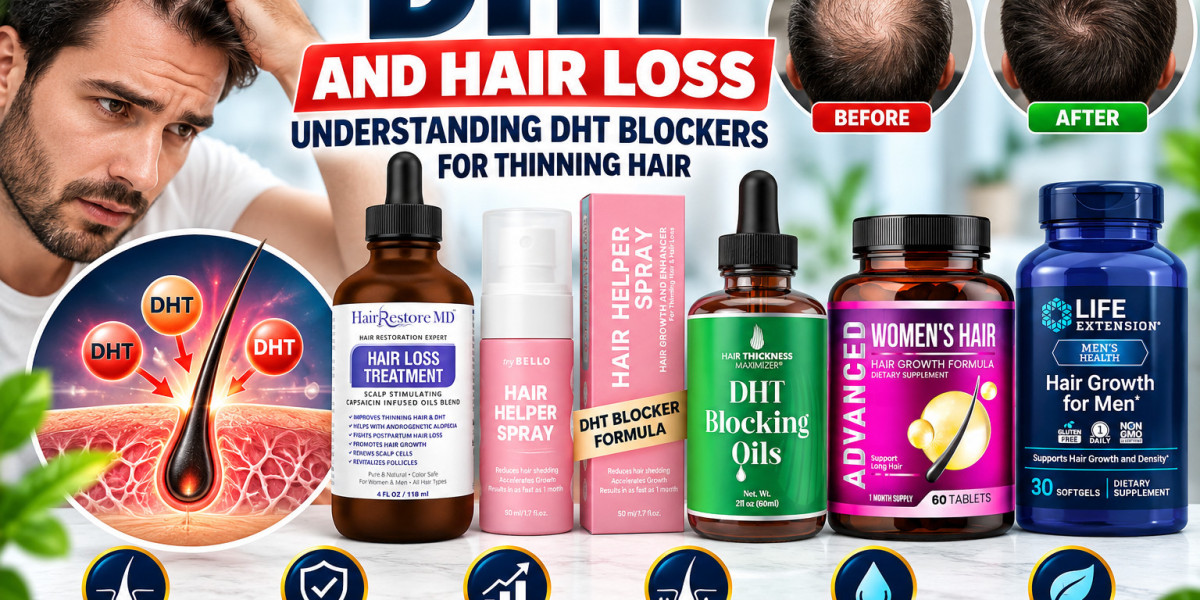

Hair thinning can be frustrating, especially when it develops gradually and becomes more noticeable over time. For many people with pattern hair loss hormones and genetics play an important role. One hormone that receives considerable attention in this area is dihydrotestosterone (DHT).
You may have seen products marketed as DHT blockers DHT-blocking supplements, or hair loss products designed to reduce the effects of DHT. But what exactly is DHT, how is it connected to hair loss, and what does a DHT blocker actually do?
Understanding the difference between medically supported treatments and products with less established evidence is important before starting any hair growth treatment.
What Is DHT?
Dihydrotestosterone, commonly called DHT, is an androgen hormone produced when the body converts testosterone through an enzyme called 5-alpha-reductase. DHT binds to androgen receptors and plays important roles in several tissues.
DHT is not simply a "bad hormone." It has normal biological functions. The relationship between DHT and hair depends partly on the location of the hair follicles and their genetic sensitivity to androgen signaling.
In people genetically predisposed to androgenetic alopecia, certain scalp follicles are particularly sensitive to DHT. This sensitivity can contribute to progressive follicle miniaturization and shorter growth phases.
Research indicates that 5-alpha-reductase activity and androgen-receptor signaling are important parts of the biology of androgenetic alopecia.
This is why treatments that affect DHT production or its effects have become an important part of the discussion surrounding DHT hair loss.
What Is the Relationship Between DHT and Hair Loss?
The connection between DHT and hair loss is most clearly established in androgenetic alopecia, commonly called pattern hair loss.
In genetically susceptible follicles, androgen signaling can gradually cause follicles to become smaller. As follicles miniaturize, the hairs they produce can become finer and shorter. Over time, the affected areas may appear increasingly thin.
This process is different from normal daily shedding. Hair naturally goes through growth, transition, resting, and shedding phases. Losing some hair every day does not necessarily mean that someone has androgenetic alopecia.
The American Academy of Dermatology notes that hereditary hair loss is the most common cause of hair loss worldwide and can affect both men and women. In men it is generally called male pattern hair loss, while women can develop female pattern hair loss.
DHT is one important factor, but genetics and follicle sensitivity also matter. In other words, simply having DHT in the body does not mean someone will automatically develop significant hair loss.
This distinction is important when evaluating claims made by DHT blocker products.
Who Is More Likely to Experience DHT-Related Hair Loss?
DHT-related hair loss is particularly associated with people who have a genetic susceptibility to androgenetic alopecia.
Men
Male pattern hair loss commonly appears as:
· A receding hairline
· Thinning around the crown
· A gradually expanding bald spot
· Reduced density on the top of the scalp
· Progressive miniaturization of individual hairs
The American Academy of Dermatology reports that male pattern hair loss can begin relatively early and tends to develop gradually over time.
Women
Women can also develop androgenetic or female pattern hair loss. It often appears differently, with overall thinning or a widening central part rather than the classic receding hairline seen in many men.
Hormonal factors can contribute, but female hair loss has multiple possible causes. Therefore, assuming that DHT is responsible for every case of female hair thinning can lead to inappropriate treatment.
People With Other Types of Hair Loss
Not every type of hair loss is DHT-related.
Sudden shedding, patchy bald spots, scalp inflammation, nutritional deficiencies, thyroid problems, certain medications, and other conditions can produce hair loss.
For this reason, determining the cause is an important first step before choosing a hair loss prevention strategy. The AAD recommends professional evaluation because different causes can require different treatments.
What Are DHT Blockers?
DHT blockers are substances or medications intended to reduce DHT production, reduce its activity, or interfere with androgen-related effects on hair follicles.
The term "DHT blocker" is used broadly in the hair-care industry, so it is important to distinguish prescription medications from cosmetic products and dietary supplements.
One of the best-established medical approaches is the use of 5-alpha-reductase inhibitors. These medications reduce the conversion of testosterone into DHT.
Finasteride
Finasteride is a prescription 5-alpha-reductase inhibitor used to treat male pattern hair loss. The FDA-approved U.S. labeling identifies 1 mg finasteride as a treatment for male pattern hair loss in men.
By inhibiting type II 5-alpha-reductase, finasteride lowers DHT levels and can slow progression of male pattern hair loss. The American Academy of Dermatology reports that clinical evidence shows finasteride can slow further hair loss in many men, with some experiencing regrowth.
Finasteride is a prescription medication and is not appropriate for everyone. Potential adverse effects need to be discussed with a healthcare professional before use.
Dutasteride
Dutasteride inhibits both type I and type II 5-alpha-reductase. It can reduce DHT more extensively than finasteride, but its use for hair loss varies by country and clinical practice, and it is not simply interchangeable with finasteride.
Because these medications affect hormone metabolism, they should be used under appropriate medical guidance.
Different Types of DHT-Related Hair Loss Products
Not every product marketed as a DHT blocker works in the same way or has the same level of evidence.
Topical Products
Some topical products are marketed as DHT blockers or anti-DHT treatments. These may contain ingredients intended to support scalp health or influence androgen-related pathways.
However, a product being labeled a "DHT blocker" does not automatically mean that it has the same evidence as a prescription 5-alpha-reductase inhibitor.
When evaluating a topical product, check:
· Active ingredients
· Concentration
· Intended use
· Clinical evidence
· Application instructions
· Safety information
· Whether claims are supported by human studies
Some hair products may be designed primarily for scalp conditioning or cosmetic improvement rather than treating androgenetic alopecia.
Supplements
DHT blocking supplements are another popular category. Products may contain ingredients such as botanical extracts, vitamins, minerals, or other compounds marketed for hair support.
However, supplements should not automatically be considered equivalent to prescription DHT-lowering medications.
The American Academy of Dermatology cautions that taking excessive amounts of certain nutrients can actually be harmful and recommends addressing documented deficiencies rather than assuming that more vitamins will improve hair growth.
For example, biotin, iron, or zinc supplementation may be appropriate when a deficiency exists, but taking high doses without a demonstrated need is not necessarily beneficial.
Other Approaches
DHT-related treatment is only one part of the broader hair-loss treatment landscape.
Depending on the diagnosis, a dermatologist may discuss treatments such as:
· Minoxidil
· Prescription medications
· Low-level laser devices
· Hair transplantation
· Other condition-specific treatments
The appropriate approach depends on the cause, severity, age, sex, medical history, and other individual factors.
DHT Blockers vs Minoxidil
DHT blockers and minoxidil are often discussed together, but they work differently.
DHT blockers such as finasteride target an androgen-related pathway by reducing the conversion of testosterone into DHT.
Minoxidil, on the other hand, does not work by blocking DHT. It is a topical hair-growth treatment that can stimulate hair growth and help maintain hair thickness in certain types of hair loss.
The AAD identifies topical minoxidil and finasteride as established treatments for male pattern hair loss. They can sometimes be used as part of the same treatment plan because they work through different mechanisms.
This difference explains why searching for a hair growth treatment should not be limited to products labeled "DHT blocker."
The objective should be to match the treatment to the cause of the hair loss.
What Should You Consider Before Using a DHT-Related Product?
Before purchasing or using DHT-related hair loss products, consider the following questions.
1. Do I Know the Cause of My Hair Loss?
This is perhaps the most important question.
If the hair loss is caused by androgenetic alopecia, DHT-related treatment may be relevant. If it is caused by another condition, a DHT blocker may not address the underlying problem.
2. Is the Product a Medication or Supplement?
Prescription medications have different regulatory requirements and evidence standards than dietary supplements or cosmetic products.
Understand what category the product belongs to before making a decision.
3. What Evidence Supports the Ingredients?
Look beyond phrases such as "natural DHT blocker" or "advanced hair formula."
Check whether there are controlled human studies supporting the ingredient and whether those studies apply to the concentration and formulation in the product.
4. What Are the Potential Side Effects?
Hormone-related medications can have side effects. Finasteride, for example, can cause sexual and other adverse effects in some users, which is why medical consultation is important before treatment.
5. How Long Will Treatment Need to Continue?
Hair-growth treatments generally require patience and ongoing use. The AAD notes that established treatments such as minoxidil and finasteride require continued treatment to maintain their benefits.
6. Could Another Treatment Be More Appropriate?
A dermatologist can help determine whether minoxidil, a prescription medication, another treatment, or a combination makes sense for the particular type of hair loss.
Common Misconceptions About DHT
Myth 1: DHT Is Always Bad
DHT has normal biological functions. The problem in androgenetic alopecia is the interaction between androgen signaling and genetically susceptible hair follicles.
Myth 2: Everyone With High DHT Will Go Bald
Hair loss is more complicated than simply having a high DHT level. Follicle sensitivity, genetics, androgen receptors, and local scalp biology all influence the process.
Myth 3: Every DHT Blocker Works Like Finasteride
They do not. "DHT blocker" is a broad marketing term. Prescription 5-alpha-reductase inhibitors have substantially different evidence and mechanisms from many supplements and cosmetic products.
Myth 4: DHT Is the Only Cause of Hair Loss
Hair loss has many causes. The AAD emphasizes that identifying the underlying cause is important because treatment varies depending on the diagnosis.
Myth 5: Natural Means Risk-Free
Natural ingredients can still produce side effects or interact with medications. A supplement should not automatically be assumed to be safer simply because it is plant-based.
FAQ
What are DHT blockers?
DHT blockers are medications, ingredients, or products intended to reduce DHT production or its effects. Their evidence and mechanisms vary significantly.
What is DHT hair loss?
DHT hair loss generally refers to androgenetic or pattern hair loss in which genetically susceptible hair follicles respond to androgen signaling, including DHT. The follicles can progressively miniaturize, producing thinner hairs.
Is finasteride a DHT blocker?
Finasteride is a 5-alpha-reductase inhibitor that reduces the conversion of testosterone to DHT. It is an established prescription treatment for male pattern hair loss.
Are DHT blocking supplements effective?
Evidence varies substantially between ingredients and products. Supplements should not automatically be considered equivalent to prescription DHT-blocking medications. If a nutritional deficiency is suspected, appropriate testing and professional advice can help determine whether supplementation is needed.
Are DHT blockers suitable for women?
Some DHT-related treatments may be used in women in specific circumstances, but treatment decisions are more complicated and depend on the cause of hair loss, pregnancy potential, medications, and other health factors. Prescription antiandrogen treatments require medical supervision.
Can DHT blockers regrow hair?
Some medically established treatments can slow hair loss and may produce partial regrowth in appropriate patients. Results vary, and no treatment guarantees complete restoration of lost hair.
Is minoxidil a DHT blocker?
No. Minoxidil works differently from 5-alpha-reductase inhibitors. It is a hair-growth treatment that can stimulate growth and help maintain hair thickness in certain forms of hair loss.
Should I use a DHT blocker if my hair is thinning?
The answer depends on why your hair is thinning. Pattern hair loss can involve DHT, but thinning can also result from many other causes. A healthcare professional can help determine the cause before treatment is selected.
Final Thoughts
DHT blockers have an important place in discussions about androgenetic hair loss, particularly because DHT and androgen signaling are involved in the miniaturization of genetically susceptible hair follicles.
However, not every product marketed as a DHT blocker has the same evidence. Prescription 5-alpha-reductase inhibitors such as finasteride have a substantially different evidence base from many over-the-counter supplements and cosmetic products.
If you're researching DHT blocker products look beyond marketing claims. Consider the active ingredients, evidence, potential side effects, treatment duration and most importantly the actual cause of your hair loss.
If hair thinning is sudden, patchy, unusually rapid, or accompanied by scalp symptoms, getting a professional diagnosis is particularly important. Identifying the cause can help ensure that the treatment addresses the underlying problem rather than simply treating the appearance of thinning.
Learn more about DHT and Hair Loss: https://www.overshopping.pk/hair-loss-treatment-baldness-solutions-pakistan/